Identify the Trigger Before You Change Anything
If you have tried every generic allergy checklist and still wake up congested, the problem is that you are treating a trigger you do not have. Dust mites, pollen, pet dander, and mold each require a different protocol. Washing your sheets in hot water is essential for dust mites but does almost nothing for pollen brought in on your hair. The fastest way to reduce bedroom allergens is to identify your likely culprit first, then target that specific reservoir with measurable thresholds. Below is a short symptom-based diagnostic that takes less than two minutes.
The Allergen Histamine Quiz
Answer these four questions based on your most recent allergy flare-ups. Choose the answer that feels most accurate, even if it is not every day.
| Question | Your Answer | Likely Primary Trigger |
|---|---|---|
| When are your symptoms worst? | Immediately after waking up, even if you slept with the window closed | Dust mites or pet dander |
| When are your symptoms worst? | Mid-morning or after you have been outside | Pollen |
| What is the main symptom? | Stuffy nose, dark circles under the eyes, mild cough | Dust mites |
| What is the main symptom? | Itchy, watery eyes plus sneezing bursts | Pollen or pet dander |
| What is the main symptom? | Wheezing, chest tightness, or asthma flare that wakes you up | Dust mites or mold (often both) |
| What do you notice when you walk into the bedroom? | A musty or dusty smell, even when the room looks clean | Hidden dust-mite debris or mold in the HVAC system |
| Do symptoms improve when you sleep in another house? | Yes, but only after two or three nights away | Dust mites in the mattress or bedding |
| Do symptoms improve when you sleep in another house? | Yes, within one night | Pollen blown in from outside or pet dander on upholstered furniture |
If you show a mix of answers, start with the trigger that matches your worst symptom. In my experience helping people with chronic bedroom allergies, most bedrooms have more than one problem. But there is almost always one dominant reservoir that pushes symptoms over the edge.
Key takeaway: Do not buy an air purifier or a dehumidifier yet. Do the two-minute quiz, because the tool that works for dust mites is often a waste of money for pollen.
Why Your Bedroom Is an Allergen Hotspot
You spend seven to nine hours in a small, enclosed space with your face pressed into a fabric surface. That alone makes the bedroom the most concentrated allergen exposure you get all day. But there is a second reason people ask, “Why am I so allergic to my bedroom?” It is the one room where we rarely change the airflow.
The rest of your home gets natural cross-ventilation from doors opening and closing, hallway traffic, and central HVAC returns. The bedroom door is usually shut at night. That creates a sealed box where airborne particles settle onto the same horizontal surfaces: your mattress, pillow, nightstand, and the top of the ceiling fan blades. During the night, you breathe that fine dust back up from the pillow. The concentration matters more than total dust. A tiny amount of allergen in your breathing zone can trigger a full response.
Another hidden factor is the “particle reservoir” effect. Soft surfaces like fabric headboards, curtains, and plush rugs act as sponges. They capture allergen particles and release them slowly whenever the air moves. A ceiling fan on low speed can turn a clean-looking room into a dust storm. Most people do not realize that a visibly clean room can still have invisible allergen reservoirs sitting inches from your face.
How to Tell If Your Bedroom Has Dust Mites
Dust mites are microscopic, so you will never see them. Their allergen is a protein in their feces and decayed bodies, and those particles are light enough to float into the air when you move. You cannot spot the mites themselves, but you can detect their presence with two practical signs.
First, check for the “pillow crease test.” Unzip and peel back the pillowcase and look at the seam of the pillow. If you see a fine, dark gray powder trapped in the fabric weave, that is a mix of skin cells, dust-mite droppings, and fabric fibers. It is not a scientific test, but it is a strong indicator that mites are reproducing in that pillow. Second, test the musty smell. Dust mites produce guanine, a chemical byproduct that gives heavy dust a slightly sweet, musty odor. If you wake up with a stuffy nose and your bedroom has a subtle musty note even when the windows are closed, mites are likely involved.
For a definitive answer, you have two options. An allergist can do a skin-prick or blood test for dust-mite-specific immunoglobulin E. At home, you can buy a dust-mite allergen collection kit from a reputable lab, mail in a sample from your mattress, and get a lab result. The at-home test is useful if you want a baseline number before and after a cleaning protocol. The downside is cost, roughly $50 to $90 per sample.
The Targeted Reduction Protocols
Here is where the advice changes from generic to specific. Choose the protocol that matches your quiz result. These protocols can be combined, but start with the dominant one.
Protocol 1: Dust Mite Control – Temperature and Humidity
Dust mites thrive at humidity above 50% and temperatures between 68 and 77 degrees Fahrenheit. They survive by absorbing moisture from the air through their skin. You cannot drop the temperature low enough to kill them, but you can control humidity and heat.
Keep the bedroom humidity below 50%, ideally between 40% and 45%. A digital humidity monitor costs about $15 and gives you a real number. If the monitor reads above 50%, run a dehumidifier with a drain hose so you do not have to empty the tank every morning. I have seen people buy a compact dehumidifier and then complain it does nothing; the unit was too small for the room. For a standard 12-by-12 bedroom, you need a dehumidifier rated for at least 30 pints per day.
Wash all bedding in water at 130 degrees Fahrenheit or higher, because lower temperatures clean the fabric but do not kill the mites. If your washing machine has a sanitize or steam cycle, that is the one to use. Dry everything in a hot dryer for at least 30 minutes. Wash your pillows every two to three months unless the label says dry clean only.
When I first started testing this protocol, I made the mistake of washing the sheets but ignoring the duvet. The duvet is often the biggest mite reservoir because it is large, thick, and washed rarely. Now I recommend laundering the duvet cover every week and the duvet insert itself once a month. If the insert cannot be washed, put it in a hot dryer for 45 minutes, which kills mites effectively.
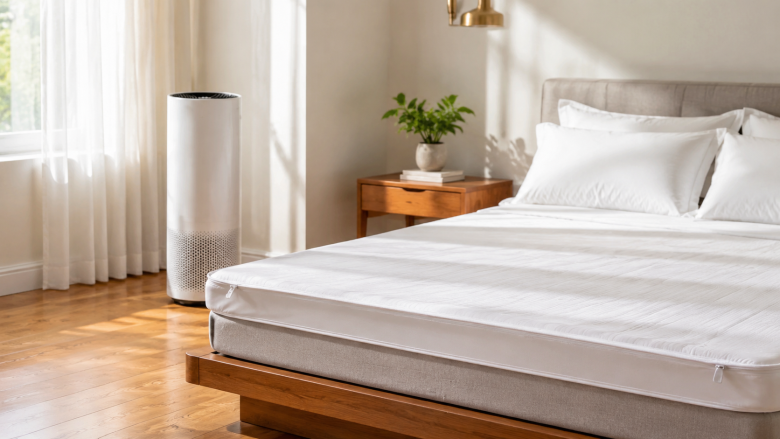
Vacuum the mattress directly every time you change the sheets. Use a vacuum with a HEPA filter and a bare-floor attachment. The attachment matters more than the vacuum brand. A regular beater bar can kick dust into the air instead of capturing it. Once the mattress is vacuumed, zip it into a dust-mite-proof cover. Choose a cover with a woven fabric that has a pore size under 10 microns. Avoid vinyl or plastic covers that trap body heat and make you sweat, which raises local humidity.
Protocol 2: Pollen Control – The Airflow Boundary
Pollen does not breed in your bedroom. It comes from outside, carried on your hair, skin, clothes, and pet fur. It also floats in through open windows and gaps around the frame. The solution is not to wash sheets more often; it is to create a boundary between the outdoors and your breathing zone.
Start by showering immediately before bed, not in the morning. Wash your hair thoroughly if you spent any time outside during pollen season. Hair acts like a pollen trap, and when you lie down, your hair smears pollen across the pillowcase for eight hours. If you do not want to shower at night, at least wash your face and change into clean sleep clothes.
Keep the window closed during peak pollen hours, which are typically mid-morning and early evening in most regions. If you love fresh air, open the window at night after rain has washed the air clean, then close it before the morning pollen release. Do not rely on window screens to block pollen; they only stop insects.
Check the weather stripping around your bedroom window and door. Press a dollar bill against the window frame and close the window. If the bill slides out with resistance, the seal is fine. If it falls out easily, air is moving through the gap. Replace the weather stripping or use a draft stopper at the base of the door. Air leaks are the invisible highways for pollen particles.
If you have central HVAC, use a filter with a MERV rating of at least 8, and ideally 13 when pollen counts are extreme. A MERV 13 filter captures more particulate matter, but it also restricts airflow. If your system is older, a MERV 13 can strain the blower motor. In that case, use MERV 8 and change it monthly in pollen season. If you use a standalone air purifier for pollen, place it near the window or the door, not on the nightstand. Pollen enters from those edges, so the purifier should intercept the airflow path.
One popular mistake is running an air purifier all day with the windows open. That does not work. The purifier can only clean a finite volume of air in a closed space. Keep the space sealed, then let the purifier do its job.
Protocol 3: Pet Dander Control – The Zone Management Strategy
If you own a dog or cat, you already know the honest trade-off: keeping a pet in the house means dander will be present. The goal is not to eliminate dander, it is to keep the bedroom as a low-dander zone that the pet does not sleep in. This is not a suggestion; it is the single most effective measure for pet allergies. The difference between letting the dog sleep on the bed and keeping it off is enormous because it affect your breathing zone overnight.
Washing the pet weekly reduces dander but does not remove it all. Some vets caution that too-frequent bathing dries out a pet’s skin, which can increase dander shedding. A monthly bath plus a daily wipe with a damp microfiber cloth is a practical compromise that most owners can maintain.
In the bedroom, remove or isolate the fabric surfaces the pet lies on. Upholstered chairs and dog beds on the carpet hold deep dander. Move the pet bed out of the bedroom entirely if possible. If you cannot, wash the pet bed cover weekly in hot water with the same 130-degree cycle you use for your linens.
For carpeted bedrooms, a HEPA vacuum is not a luxury, it is a necessity. Non-HEPA vacuums can pass small dander particles straight through the exhaust and re-circulate them into the air. Vacuum twice a week, and focus on the areas where the pet sleeps. If you are still waking up congested, consider removing the carpet and using washable area rugs. Carpet is the single deepest dander reservoir in a bedroom.
Most people never think about the ceiling fan. Dander and dust accumulate on top of the blades, then the fan’s airflow launches them into the breathing zone. When did you last wipe the top of the blades? I once worked with a family who had tried four different air purifiers and still sneezed all night. The solution was a ceiling fan with a thick layer of fine dust on the top edge. Vacuum and wipe the blades monthly, preferably with a damp cloth so the dust sticks to the cloth instead of falling onto the bed.
Protocol 4: Mold Control – The Moisture Hunt
Mold needs three things: a food source, the right temperature, and moisture. You cannot remove the food source from drywall, wood, or fabric, but you can remove the moisture. The goal is to keep the bedroom below 50% humidity and to find the wet spots that tend to stay hidden.
Start with a targeted visual inspection. Look at the window sills for condensation streaks, the wall behind the headboard, the corners near the ceiling, and the area around the baseboard on exterior walls. Use a flashlight and check for black or dark green specks that do not rub off easily. If you have noticed a musty smell in the bedroom, mold is a more likely culprit than dust mites, which have a different, less pungent odor.
If you see visible mold, do not paint over it. The paint will peel, and the mold will continue to release spores into the room. Small patches on non-porous surfaces like tile or glass can be cleaned with a mixture of water and mild detergent. For drywall or wood, the contaminated material often needs to be removed and replaced. If the patch is larger than a few feet square, call a professional mold remediation company. This is not a job for home cleaning products.
To prevent mold, target where moisture collects. Keep indoor plants out of the bedroom or switch to plants that do not require constantly moist soil. The soil itself can harbor mold spores, and watering plants adds humidity to the air. If you keep plants, water them, let the surface dry, and do not let water sit in the saucer. Also, inspect the box spring under your bed. If the box spring sits directly on a concrete slab or a cold floor, condensation can form and feed mold. Place a moisture barrier between the box spring and the floor.
Step-by-Step Diagnostic and Action Plan
Even with a clear quiz result, it helps to have a repeatable process. Follow this order once a month to stay ahead of allergens.
- Measure the humidity. Place a digital monitor at pillow height near the bed. Record a reading in the morning and evening. If either number is above 50%, run a dehumidifier for that day.
- Check the ventilation inlets. Close the windows and test the weather stripping with the dollar-bill method. Replace any weak seals.
- Clean the breathing zone. Vacuum the mattress, pillows, and the creases where the bed meets the headboard. Wipe the ceiling fan blades with a damp cloth. Vacuum the floor under the bed.
- Wash the fabric in hot water. Use the 130-degree cycle for sheets, pillowcases, duvet cover, and any washable fabrics like throw blankets. Dry on high heat.
- Reset the air purifier filter. Check the pre-filter on your unit weekly and vacuum it. Replace the HEPA filter according to the manufacturer’s schedule, not when it looks dirty. Most HEPA filters need replacement every 6 to 12 months.
If you share a bedroom with a partner who does not have allergies, the plan still works. The partner is not the source of the allergens. The source is the mattress, the air, or the dust. Run the same protocol and let your partner keep their pillows; you cannot choose to be less allergic, but you can choose to remove the trigger.
Practical Tools and the Right Way to Use Them
You do not need every device on the market. You need the right device for your identified trigger, and you need to use it at the right size and location.
Air Purifiers: Match the CADR to the Room Size
Many people buy a compact air purifier and place it on a nightstand, expecting the whole room to be cleaned. Air purifiers are rated by their Clean Air Delivery Rate, or CADR. A unit with a CADR of 100 is suitable for a small room of about 100 square feet. The average master bedroom is around 200 square feet, which requires a CADR of at least 200. Higher is better, but too high can create uncomfortable airflow.
Look for a purifier with a true HEPA filter, not an Ionic or electrostatic model that produces ozone. Ozone is a lung irritant and will make allergy symptoms worse, even if it neutralizes some odors. The EPA has cautioned against ozone-generating air purifiers. Stick with HEPA for particle removal and add a carbon pre-filter for volatile organic compounds if you have strong smells.
Dehumidifiers: Size and Drainage Matter
For dust mites and mold, a dehumidifier is more effective than an air purifier because it changes the environment where allergens breed. The unit must have a rated capacity that matches the room. Buy one with a built-in humidistat and set it to 45%. Choose a model with a continuous drain option; you can run a hose to a floor drain or a container that you empty daily. An empty tank stops the dehumidifier, and if that happens while you sleep, the humidity will drift back up.
Washable Fabrics: The Underrated Ally
If you are replacing bedroom furniture or decor, choose materials that can go in the washing machine. Cotton or linen curtains wash better than heavy velvet. A tufted upholstered headboard is a beautiful dust trap; a wood, metal, or leather headboard wipes clean in seconds. If you love the soft aesthetic, use a washable slipcover on the headboard and launder it monthly. The same logic applies to throw pillows and bed skirts.
Measurable success: Track your symptoms on a simple 1-to-10 scale every morning for two weeks after starting a protocol. A reduction of 3 points or more means you are targeting the right reservoir. If the score stays flat, re-take the quiz and switch your focus.
The Forgotten Allergen Reservoirs You Have Not Checked
Here is the insight that separates a surface-level article from a genuinely effective plan. The places below are the ones I have seen cause the most confusion and frustration. They rarely show up in standard checklists.
The Upholstered Headboard
Your headboard sits directly behind your pillow. Every night, the airflow from your breathing moves across the headboard surface. If it is fabric, it is absorbing dust, dead skin cells, and dander from the air. A tufted or buttoned headboard is even worse because the buttons create crevices where particles lodge. Vacuum it weekly with the upholstery attachment, and wash the cover if it is removable. If you have a serious dust mite allergy, consider replacing a fabric headboard with a cleanable one. It sounds dramatic, but it is the single most direct exposure point in the bed.
The Bed Skirt
A bed skirt drags on the floor and creates a dark, warm microclimate under the bed. That is exactly what dust mites and mold spores need for growth. The bed skirt acts as a vertical pathway for dust particles to travel up the side of the bed and into your breathing zone. Wash it in hot water at least once a month, and vacuum the bare floor underneath the bed weekly. Better yet, remove the bed skirt entirely if you are willing to show the legs of the bed. Out of sight is not out of breathing range.
Ceiling Fan Blades
I mentioned this earlier, but it bears repeating because it is so widely ignored. Ceiling fans are designed to move air, which means they are also designed to move dust. The top of each blade is a hidden shelf that collects a layer of fine dust. When the fan spins, gravity pulls some of that dust off the edges and straight down into the bed. Clean the blades monthly with a damp microfiber cloth, and run the fan for five minutes with the windows closed before you vacuum, so loosened dust settles on surfaces you can then wipe.
The Space Under the Bed
Look at what is stored under your bed. Suitcases, boxes, old sneakers, and out-of-season clothes collect dust and hide moisture. If you use this space for storage, pack items in sealed plastic bins with lids, not cardboard boxes. Cardboard is porous and absorbs moisture, which turns into a mold farm over time. Vacuum under the bed at least every other week. If you cannot reach, buy a flat vacuum attachment that fits under the low clearance.
The Closet
Bedroom closets are often poorly ventilated, and they contain clothes that trap dust and dander. If the closet shares a wall with a bathroom, humidity can migrate through the drywall. Keep the closet door closed, run a small moisture absorber inside during humid months, and wash clothes that have hung in the room for months before you wear them. The air in a musty closet is not separate from the air in the bedroom; it leaks through the door gap every time you open it.
When to Call in a Professional
If you have followed the targeted protocol for six weeks and your morning congestion, sneezing, or asthma has not improved, it is time for professional help. An allergist can perform skin testing to identify exactly what you are reacting to, and they can prescribe antihistamines, nasal corticosteroids, or allergen immunotherapy. Immunotherapy, either allergy shots or sublingual drops, is the only treatment that changes the immune response rather than just masking symptoms.
Also consider a professional home inspection if you suspect hidden mold inside walls, under flooring, or in the ductwork. You cannot clean mold you cannot see. A certified mold inspector uses moisture meters and air sampling to locate the source. That is worth the cost if you have tried everything and still smell a musty smell.
For severe cases, a HEPA air purifier in the bedroom can help, but it only filters the air. It does not clean the mattress, the curtains, or the headboard. The air purifier is the final line of defense, not the primary treatment. Use it after you have removed the reservoirs it is trying to clean.
Build a Calming Bedroom That Is Also an Allergy-Free Zone
Once the allergen sources are controlled, you can focus on the rest of the sleep environment. A low-allergen bedroom feels cleaner, smells fresher, and supports deeper sleep. That matters because the stress of chronic allergies can keep you awake even when your nose is clear. For more on the broader sleep environment, see our guide on how to set up a calming bedroom.
Similarly, a consistent bedtime routine helps regulate your circadian rhythm, which in turn improves your immune response. Allergens are harder to tolerate when you are sleep-deprived. If you want a practical wind-down routine that pairs well with this allergen protocol, read our article on bedtime tips to reduce evening stress.
Your Weekly Allergen Reset Checklist
Print this list and keep it in your phone. It is the distilled version of everything above, organized by frequency. The entire weekly reset takes about 25 minutes.
- Every day: Close the bedroom door and windows during peak pollen hours. Make the bed so the mattress can air out, and keep the bed skirt pulled up or the floor clear.
- Twice a week: Vacuum the floor and under the bed with a HEPA vacuum. Wipe the top of the ceiling fan blades with a damp cloth.
- Weekly: Wash sheets and pillowcases in hot water at 130 degrees Fahrenheit. Vacuum the mattress and the upholstered headboard. Wipe down the nightstand and any hard surfaces.
- Monthly: Wash the duvet cover, curtains, and any throw blankets. Clean the bed skirt or remove it. Check and replace the HVAC filter. Test the humidity monitor and note any reading above 50%.
- Seasonally: Rotate and vacuum the mattress, flip it if your model allows. Wash the pillows or replace them if they have yellowed or lost shape. Inspect the weather stripping around the window and door and replace it if damaged.
Your bedroom will never be a sterile cleanroom, and it does not need to be. The goal is to reduce the allergen load below the threshold that triggers your symptoms. If you wake up with clear airways and no itchy eyes, you have won. The quiz, the humidity measure, the wash temperature, and the reservoir checklist are the tools that get you there.
Start with the quiz tonight. Identify your likely trigger, pick the matching protocol, and set a measurable goal: humidity below 50%, bedding washed at 130 degrees, and no visible dust on the ceiling fan blades. In two weeks, rate your symptoms again. I have seen people follow this exact sequence and see a dramatic shift within a week. The difference is not magic. It is targeting the right reservoir with the right method, instead of throwing a dozen generic tips at the wall.