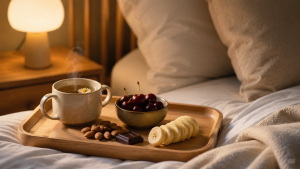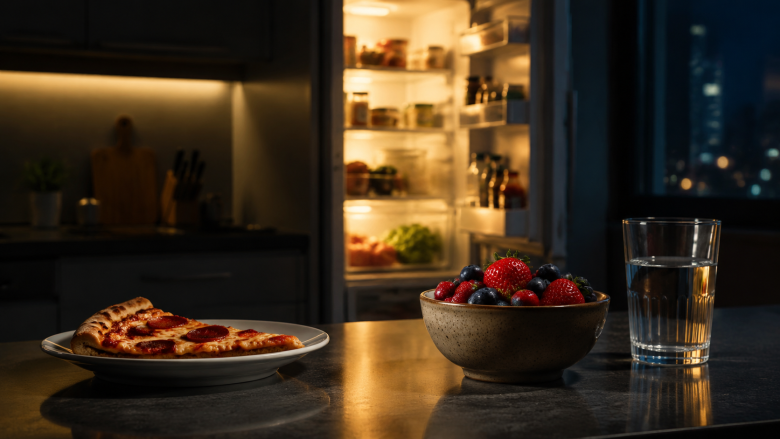
You are hungry at 10pm. You have already brushed your teeth, but now you are standing in front of the fridge. Should you eat, or should you walk away?
The honest answer is: it depends. Eating late is not automatically bad for you, and skipping a meal when you are genuinely hungry can ruin your sleep and set you up for a rough next day. The problem is that most advice treats every late-night craving as a failure of willpower. That misses the real question, which is whether your body actually needs fuel or whether your brain is looking for a distraction.
Here is a simple decision framework that has helped me stop guessing. Instead of asking “should I eat?”, ask yourself three questions: Am I actually hungry? How much time do I have before bed? What do I have planned for tomorrow? Your answers determine whether you should have a small snack, a real mini-meal, or nothing at all.
The Late-Night Eating Decision Tree: A Three-Step Gut Check
I have spent years counseling clients who were convinced they were “night eaters” and just needed more discipline. In almost every case, the problem was not discipline. It was that they had no system for telling real hunger apart from the other things that make us open the fridge at night.
This is the framework I use. It takes about sixty seconds and it works for 10pm cravings, 2am wake-ups, and everything in between.
Step 1: Rate Your Hunger on a Scale of 1 to 10
Before you eat anything, pause and rate your hunger. A 1 means you feel nothing. A 10 means you are so hungry you feel shaky, nauseous, or unable to focus. Most people who think they are hungry at night are actually at a 3 or 4, which is not real hunger. That is a craving. Real hunger usually shows up around a 7 or higher, and it feels different. Your stomach may growl, you may feel empty, or you may notice that thinking about food is making your mouth water.
If you are at a 3 or 4, you are probably bored, stressed, or following a habit. If you are at a 7 or above, your body is telling you it needs fuel. That distinction matters because the response is different. A craving responds to distraction. Real hunger responds to food.
Here is the thing nobody tells you: if you are genuinely hungry at 10pm, eating a small, balanced snack is better than trying to white-knuckle it and then waking up at 3am starving. I used to think skipping the snack was the victory. Then I learned the hard way that a 3am wake-up call from an empty stomach wrecks your sleep quality way more than a 150-calorie snack before bed ever will.
Step 2: Consider Your Time Horizon
How long until you actually lie down and close your eyes? This is not the same as when you get into bed. If you sit up scrolling on your phone for another hour, your body has time to digest. If you are eating at 2am and planning to sleep immediately after, your choices should be lighter.
For most people, the ideal window is to finish eating at least one hour before lying down. That gives your stomach time to start emptying and reduces the risk of acid reflux or heartburn. If you have less than an hour, keep the portion small and avoid foods that are greasy, heavily spiced, or high in added sugar.
Your next-day plan also matters. If tomorrow is a rest day, you have more flexibility. If you have a 6am workout or an important presentation, you might choose differently. A bowl of oatmeal at 11pm is fine on a normal night, but if you are doing a fasted workout at 6am, you may want something with a bit more protein to carry you through.
Step 3: Decide Which Route You Are On
Based on your hunger rating and your time horizon, you now have three honest options. I call them the three routes: the Sleep-Inducing Snack, the Satisfying Mini-Meal, and the Non-Food Alternative. Each one has a specific purpose, and none of them involve shame.
If you are at a 7 or above and you have more than an hour before bed, you are on the mini-meal route. If you are moderately hungry, maybe a 5 or 6, and bedtime is close, you are on the snack route. If you are below a 5 and you just want to chew on something, you are on the non-food route.
Most people only know about the snack route. They eat a handful of almonds, still feel unsatisfied, and then wonder why they are standing in the kitchen again twenty minutes later. That happens because they needed a mini-meal, not a snack. The reverse is also true. I have seen clients eat a full bowl of pasta at midnight when a glass of warm milk and a few crackers would have done the job better.
Route 1: The Sleep-Inducing Snack (For Mild Hunger Close to Bedtime)
This route is for when you are hungry enough to notice it, but not so hungry that a snack would leave you unsatisfied. It is also for the 2am version of hunger, where you wake up, feel a pang, and need something light that will not keep you awake.
The goal here is not to fill you up. It is to take the edge off so you can fall asleep and stay asleep. The best snacks combine a small amount of complex carbohydrate with a modest source of protein. Carbohydrates help tryptophan cross into the brain, and protein provides the building blocks for serotonin and melatonin. This is why the classic sleep-snack combinations are not random.
What Is the Healthiest Thing to Eat Late at Night?
If you want the single healthiest late-night snack, look for three things: under 200 calories, under 5 grams of added sugar, and a ratio of roughly 2:1 carbs to protein. That formula is practical, not magical. It gives you enough fuel to stop the hunger without spiking your blood sugar or leaving you too full to sleep.
My go-to examples include a small banana with a spoonful of peanut butter, half a turkey sandwich on whole wheat bread, a small bowl of plain Greek yogurt with berries, or a handful of almonds with a few dark chocolate chips. These foods are healthy because they are minimally processed and they provide real satiety. A bowl of cereal with skim milk can work too, but it is easy to overshoot the portion, and the added sugar can cause a blood sugar dip in the middle of the night.
One thing I learned from my own 2am experiments: texture matters more than you think. A snack that requires some chewing, like apples or raw vegetables, sends stronger fullness signals to your brain than something you drink or swallow in three bites. I used to drink a glass of milk when I woke up hungry, and it never worked. I switched to a small apple with peanut butter, and the difference was night and day.
Portion Control Without Obsessive Measuring
You do not need to weigh your food at midnight. Instead, use your hand as a rough guide. For a snack, keep it to about one cupped palm of food. That is roughly a quarter cup of nuts, a small piece of fruit, or a single slice of toast with toppings. If you are still hungry after fifteen minutes, you can have a little more, but the pause is important.
The fifteen-minute rule is the most underrated tool in late-night eating. When you eat quickly, your brain does not receive the fullness signal until about twenty minutes later. If you finish a snack in three minutes and still feel hungry, that is often just the signal delay, not genuine hunger. Wait fifteen minutes and reassess. Most people do not need a second serving.
If you struggle with eating an entire box of crackers in one sitting, switch to snacks that are naturally portioned. String cheese, single-serve yogurt cups, and individually wrapped dark chocolate squares are your friends. It is not about being weak. It is about designing your environment so you do not have to exercise willpower at the moment you are tired and hungry.
Route 2: The Satisfying Mini-Meal (For Real Hunger, Especially at 2am)
Sometimes a snack is not enough. If you skipped dinner, had a very early dinner, or worked a late shift, your body needs actual food. This is especially true for shift workers. If you are reading this at 2am before your overnight shift, or at 2am after waking up genuinely starving, you are not being weak. You are responding to a legitimate biological need.
The mini-meal route is for hunger ratings of 7 or higher. It is also for anyone who knows from experience that a snack will just make them hungrier. Some people feel worse after eating a small snack because it stimulates their appetite without satisfying it. If that sounds like you, skip the snack and go straight to a mini-meal.
What Food Can I Eat at 2am?
At 2am, your digestive system is still active, but it is slower than it is at 7pm. The goal is to eat something that is easy to digest, provides steady energy, and does not cause a blood sugar crash. You want protein, a little bit of fat, and a moderate amount of carbohydrate. You do not want a heavy, greasy meal that will sit in your stomach for hours.
My favorite 2am mini-meals are: scrambled eggs with a slice of whole grain toast, a small bowl of leftover soup with a piece of cheese, instant oatmeal made with milk and a scoop of protein powder, or a quesadilla with black beans and a sprinkle of cheese. These take less than ten minutes to make and they hit the satiety sweet spot.
One mistake I made when I worked an overnight job was eating a full fast-food burger at 3am. It tasted amazing in the moment, but I paid for it for the rest of my shift. The fat and sodium left me bloated and sluggish, and I got heartburn when I finally tried to sleep. The next week I tried a turkey sandwich with a handful of grapes, and I felt completely different. The lesson is not that fast food is evil. It is that your body at 2am prefers food that does not require a massive digestive effort.
What Do You Call a Late Night Meal?
There is no single word in English that everyone agrees on, but the most common term is a “late-night snack” if it is light, or a “midnight snack” if it happens around or after midnight. Heavier meals eaten very late are sometimes called “supper” in older or rural usage, especially if it is the last meal of the day. In the South, a late dinner might be called “supper” even at 9pm.
The lack of a clean word is actually revealing. Our culture does not have a clear category for eating at 10pm or 2am, so we default to calling it a snack even when it is really a small meal. That matters because the label shapes your expectations. If you call it a snack, you might try to eat a tiny portion and then feel deprived. If you call it a mini-meal, you give yourself permission to eat enough to actually feel satisfied.
I now tell my clients to call it what it is. If you are eating eggs and toast, that is a meal, not a snack. Eat the meal. The guilt comes from the mismatch between what you are eating and what you think you should be eating. Resolve the mismatch and the guilt goes away.
Quick Recipes for the Mini-Meal Route
These are not gourmet recipes. They are practical combinations you can make in the dark, literally. I have made all of these at 2am, sometimes without turning on the kitchen light.
- Egg and Cheese Toast: Scramble one egg in a small nonstick pan. Toast one slice of bread. Melt a slice of cheese on the toast and top with the egg. Total time: 5 minutes.
- Microwave Quesadilla: Take one small flour or corn tortilla, sprinkle with shredded cheese and a spoonful of canned beans, fold, and microwave for 45 seconds. Serve with salsa if you have it.
- Instant Oatmeal Upgrade: Cook one packet of plain instant oatmeal with milk instead of water. Stir in a scoop of vanilla protein powder and a handful of frozen berries. Total time: 3 minutes.
- Grown-Up Lunchable: A few whole grain crackers, a slice of deli turkey, a piece of string cheese, and a handful of grapes. No cooking required.
What can go wrong with the mini-meal route? The biggest issue is portion creep. A mini-meal should be about 250 to 400 calories. If you are hungry enough to eat a full 800-calorie meal, that is a sign that you probably skipped too many meals earlier in the day. That is a bigger issue to address tomorrow, not a reason to punish yourself tonight. Eat the mini-meal, and then try to eat more consistently the next day.
Route 3: The Non-Food Alternative (For Boredom, Habit, and Stress)
This route is not about suppressing your feelings. It is about recognizing that food is not the solution for every uncomfortable sensation. If you rated your hunger below a 5, food will not fix what you are actually feeling. You will eat, you will not feel better, and you will be frustrated with yourself.
The most common trigger for non-hungry late-night eating is boredom. You are tired of looking at your phone, you are not quite ready to sleep, and your kitchen is the only interesting room left in the house. The second most common trigger is stress. Eating gives you something to do with your hands and mouth, and the chewing motion is genuinely calming for some people. The third is pure habit. If you always eat a bowl of ice cream while watching TV, your brain will expect ice cream every time you sit down on the couch, regardless of whether your stomach is empty.
How to Tell the Difference Between Hunger and a Habit
Ask yourself a question that has nothing to do with your stomach: Would you eat a plain piece of chicken breast right now? If the answer is yes, you are probably actually hungry. If the answer is no, and you only want something sweet or crunchy, that is a craving, not hunger. This is the single best test I know, and it works because it removes the specific food from the equation.
Another test is the water test. Drink a full glass of water and wait ten minutes. Mild dehydration can masquerade as hunger. If the feeling disappears after the water, you were not hungry. If it persists, then it is worth taking seriously.
I remember a period when I was working from home and finding myself in the kitchen every night around 10pm. I was not hungry. I was just tired of sitting at my desk, and the kitchen was a place to stand instead of sit. When I realized that, I started doing a five-minute stretching routine in my living room instead, and the kitchen trips stopped. If you want a structured way to replace the habit, we have a guide on how to incorporate stretching into your night routine that covers exactly this kind of substitution.
Non-Food Alternatives That Actually Work
If you are going to replace the food, you need something that occupies your hands or your mouth. The best options are herbal tea, sparkling water, a piece of gum, or a hard candy if you have one. For the hands, try a fidget toy, a puzzle, or a few minutes of light stretching.
The key is to choose something that interrupts the automatic loop. If you always eat while watching TV, change where you sit or what you do with your hands. If you always eat while scrolling your phone, put the phone in another room and pick up a book. The specific alternative matters less than the disruption of the pattern.
One option that surprised me was taking a short walk. A five-minute walk around the block, or even just up and down the stairs, can reset your brain in a way that sitting still cannot. It gives you a boundary between the urge and the action. If you are looking to build this into a larger evening reset, our article on quick tips for better night routines has some overlapping ideas.
Shift Workers and the 2am Hunger Problem
Most late-night eating advice is written for people who work a normal daytime schedule and want to stop snacking after dinner. That advice falls apart for shift workers. If you work overnight, your 2am is your 2pm. Your body needs food to fuel your shift, and pretending otherwise is a recipe for low energy and poor focus.
If you work nights, the decision tree still applies, but you need to adjust the labels. Your “bedtime” is in the morning. Your “afternoon snack” might happen at 3am. The nutritional principles are the same: eat real food, prioritize protein and fiber, and avoid heavy meals right before you sleep, whenever that happens to be.
For shift workers, I recommend planning your overnight meals the same way a daytime worker plans lunch. Pack a small cooler with a sandwich, some yogurt, fruit, and nuts. This prevents the vending machine from making your decisions for you at 2am. It also ensures you are eating something that will sustain you for the rest of the shift instead of a candy bar that gives you a quick spike and then a crash.
The other thing shift workers need to know is that eating at 2am is not inherently unhealthy. Your body is not keeping a secret score of what time you eat. What matters is the quality of the food and the total amount. A 2am meal of grilled chicken and vegetables is vastly different from a 2am meal of chips and dip, even though they happen at the same hour.
How to Eat Mindfully When You Are Half Asleep
Mindful eating is easy to recommend and hard to practice at 11pm. When you are tired, your executive function is low, and you are more likely to eat quickly and overeat. But there are a few practical tricks that work even when you are half asleep.
First, serve your food on a plate or in a bowl. Do not eat from the container. This is non-negotiable. When you eat from a bag or a tub, you lose track of how much you have eaten. A plate or bowl creates a visual boundary. When the plate is empty, you have to make a deliberate choice to get up and get more, which gives your brain a moment to check in.
Second, put your fork or spoon down between bites. This is a classic technique, and it works. It slows down your eating speed and gives your stomach time to signal your brain. You do not have to do this for every meal. Just try it for your late-night snack, when the risk of mindless eating is highest.
Third, eat without a screen. This is the hardest one for me. I still catch myself eating while watching a show, and I always finish my snack without remembering it. When you eat with your eyes on a screen, you are not tasting the food, and you are not registering the fullness signal. If you cannot eat without a screen, at least pause the show for the two minutes it takes to eat a snack.
What Actually Happens to Your Body When You Eat Late?
The research on late-night eating is more nuanced than the headlines suggest. Some studies have linked late eating to weight gain and poorer metabolic health, but these studies are often confounded by the fact that people who eat late also tend to eat more total calories and make poorer food choices. It is not clear that the clock time itself is the problem.
What we know is that eating a large, heavy meal close to bedtime can disrupt sleep. Your body has to work to digest the food, which can raise your core temperature and make it harder to fall asleep. It can also trigger acid reflux if you lie down too soon after eating. These are real effects, but they are about the size and composition of the meal, not the fact that it is 10pm.
There is also evidence that eating in alignment with your circadian rhythm is beneficial, which means eating most of your calories earlier in the day if you are a daytime person. But if you are a night owl or a shift worker, your rhythm is different. The best schedule is the one you can maintain consistently while still getting enough sleep and enough food.
Building a Late-Night Eating Plan That Works for You
If you want to stop guessing, write down your personal late-night protocol. It takes five minutes and it removes the decision-making from the moment when you are hungry and tired.
Start by answering these questions: What time do you usually feel hungry at night? Is that hunger real or habitual? What foods are always in your kitchen that you could reach for? Which of those foods are on the snack route, and which are on the mini-meal route? What non-food alternative works best for you?
Once you have those answers, you can create a simple rule for yourself. For example: “If I am hungry after 10pm, I will eat a mini-meal only if I skipped dinner. Otherwise, I will have a snack from the approved list. If I am not hungry, I will drink a cup of herbal tea and do five minutes of stretching.”
This kind of plan works because it is specific and it is not punitive. It does not say “do not eat.” It says “here is what eating looks like when it is appropriate.” That is a much more sustainable approach than trying to ignore your body.
The takeaway: Late-night eating is not a moral failure. It is a decision. Use the three-step gut check to figure out what kind of decision it is, then choose the route that fits. A sleep-inducing snack for mild hunger, a satisfying mini-meal for real hunger, and a non-food alternative for everything else.
If you are looking to make your whole evening more restful, you might also find our guide on how to create a peaceful night routine helpful. The less chaotic your evening is, the less likely you are to end up standing in front of the fridge at midnight trying to figure out what you actually want.