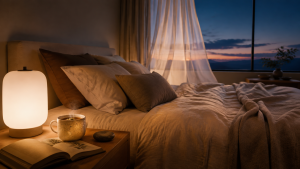
Why Your Current Wind-Down Isnt Working
If you are reading this, you have probably tried the standard advice: dim the lights, put down the phone, sip some chamomile. And maybe it worked for a night or two. But then the racing thoughts came back, or you found yourself lying awake at 2 a.m. with your jaw clenched and your mind running through tomorrow’s to-do list.
Here is the thing nobody tells you about unwinding at bedtime: it is not about doing more relaxation techniques. It is about removing the things that keep your nervous system locked in “on” mode, and then giving your body specific, physical signals that it is safe to power down. This guide covers the overlooked methods that actually move the needle, including the 3:2:1 rule, a Japanese meditation trick called shikantaza, and a simple tongue placement that relaxes your entire jaw.
I have tested all of these myself, and I have also failed at all of them at least once. So I will tell you where the pitfalls are, not just the ideal path.
The 3:2:1 Rule: The Most Overlooked Bedtime Framework
When people ask me how to properly unwind before bed, my first answer is always the 3:2:1 rule. It is a simple time-based framework that addresses the three biggest sleep killers: digestion, mental activation, and blue light exposure. The rule is straightforward:
- 3 hours before bed: Stop eating heavy meals and stop drinking alcohol.
- 2 hours before bed: Stop working, checking email, or engaging in stressful conversations.
- 1 hour before bed: Stop using screens (phone, laptop, TV) and switch to low-stimulation activities.
When I first tried the 3:2:1 rule, I made the mistake of treating it as a loose guideline. I would finish dinner at 7:30 p.m. and go to bed at 10:30 p.m., thinking that was close enough. But “close enough” does not work. Your digestive system needs a solid three hours to move food out of your stomach, and your brain needs a full hour of darkness to start producing melatonin. The moment I got strict about the timing, my sleep latency (the time it takes to fall asleep) dropped from about 45 minutes to under 15.
Why the 3:2:1 Rule Works
The science here is solid. Eating late spikes your blood sugar and keeps your core body temperature elevated, both of which interfere with the drop in temperature that triggers sleep onset. Working late keeps your prefrontal cortex engaged, making it harder to shut off the “task-positive” network in your brain. And screens emit blue light that suppresses melatonin, the hormone that regulates your sleep-wake cycle.
But the real reason the 3:2:1 rule works is that it creates a buffer zone. It gives your body a predictable sequence of events, and predictability is exactly what your circadian rhythm craves. If you do the same three things at the same three times every night, your brain starts to associate those cues with sleep. This is the foundation of building a healthy bedtime habit, which we have covered in detail in our guide to building a healthy bedtime routine.
What Nobody Tells You About the 3:2-1 Rule
Most articles present the 3:2:1 rule as a one-size-fits-all solution. It is not. The two biggest problems I hit were:
- The “hungry at 11 p.m.” problem: If you eat dinner at 6 p.m. and go to bed at 10 p.m., you might get hungry right before bed. The fix is to move your dinner later, or eat a larger lunch. A small, carb-heavy snack like a banana or a piece of toast about 45 minutes before bed is fine, but a full meal is not.
- The “I work nights” problem: If your schedule is shifted, the 3:2:1 rule still applies, but you have to shift the clock. The rule is about relative timing, not absolute hours. Stop working two hours before your bedtime, even if your bedtime is 4 a.m.
There is also a rebound effect that nobody mentions. If you are used to scrolling your phone in bed, cutting it out cold turkey will feel miserable for the first three or four nights. You will lie there feeling restless and bored. That is normal. It is your brain detoxing from the dopamine hits of social media. Push through it for one week, and the boredom turns into actual drowsiness.
The Tongue Trick: A Physical Reset for a Clenched Jaw
Now for the strangest, most effective tip in this guide: the tongue trick. If you have ever woken up with a sore jaw, headaches, or worn-down teeth, you are probably clenching your jaw at night. Most people do not realize that jaw tension is directly connected to your sympathetic nervous system (the fight-or-flight response). When your jaw is tight, your brain gets a signal that you are under threat, which keeps you in a state of hyperarousal.
The tongue trick is simple: place the tip of your tongue on the roof of your mouth, right behind your front teeth. Then, let your jaw go slack, so your teeth are not touching. Breathe through your nose and hold this position for 60 to 90 seconds.
When I first tried this, I was skeptical. It seemed too simple to do anything. But after about 30 seconds, I felt my masseter muscles (the ones that close your jaw) release in a way that I had not felt in years. It was like my entire face softened. The effect is similar to what a massage therapist does when they work on your temporomandibular joint, but you can do it yourself, in bed, in the dark.
Why the Tongue Trick Works
The tongue trick works because it forces you into a position that is incompatible with clenching. You cannot clench your jaw with your tongue on the roof of your mouth and your teeth apart. It is a physical override of a habitual tension pattern.
There is also a neurological component. The trigeminal nerve, which controls the jaw muscles, is the largest cranial nerve and has a direct line to the brainstem. When you relax the jaw, you send a signal up that nerve that says, “We are safe, we can rest.” This is the same reason progressive muscle relaxation works, but the tongue trick is faster and more targeted.
The one thing to watch out for: if you have a tongue tie, or if you naturally rest your tongue on the floor of your mouth, this position will feel awkward at first. That is okay. Start with 30 seconds and build up. Do not force it to the point of discomfort.
A Quick Caveat on Jaw Clenching
If you wake up with severe jaw pain, cracked teeth, or frequent headaches, the tongue trick is not a substitute for professional care. Chronic clenching (bruxism) can require a night guard prescribed by a dentist. Use the tongue trick as a nightly relaxation tool, but get a dental opinion if the pain is persistent.
The Japanese Trick to Sleep: Shikantaza and the Art of Doing Nothing
You have probably heard of the Japanese concept of ikigai (your reason for being) or kaizen (continuous improvement). But there is another Japanese practice that is tailor-made for bedtime: shikantaza. It translates roughly to “just sitting,” and it is a form of Zen meditation where you sit and pay attention to nothing in particular.
Here is the thing nobody tells you about trying to meditate for sleep: the harder you try to empty your mind, the louder it gets. Shikantaza is the opposite approach. Instead of trying to suppress thoughts, you simply let them pass through without engaging. You do not follow a thought, and you do not push it away. You just sit (or lie) there, aware of the present moment, without attaching to anything.
To practice shikantaza at bedtime: lie on your back with your hands at your sides. Close your eyes. Pay attention to the sensation of your breath, but do not try to control it. When a thought arises, acknowledge it (“Oh, there is a thought about work”) and let it drift away. The key is non-attachment. You are not trying to stop the thought; you are trying to stop the pulling.
The 10-3-2-1-0 Method: A Western Cousin
If shikantaza feels too abstract, there is a more structured Japanese-adjacent method called the 10-3-2-1-0 formula. It is popular in corporate wellness programs and goes like this:
- 10 hours before bed: No more caffeine.
- 3 hours before bed: No more food or alcohol.
- 2 hours before bed: No more work.
- 1 hour before bed: No more screens.
- 0 times: The number of times you hit the snooze button in the morning.
The 10-3-2-1-0 method is essentially the 3:2:1 rule with the addition of a caffeine cutoff and a morning anchor. I like it because the “0” at the end reminds you that unwinding is not just about the evening. If you are waking up groggy because you hit snooze four times, your whole circadian rhythm is shifted, and your bedtime wind-down will be less effective.
For a more structured evening plan that incorporates these timing rules, check out our effortless bedtime plan to boost energy. It walks through a step-by-step schedule.
Neurodivergent-Friendly Wind-Downs (AuDHD and Beyond)
This is the section that most bedtime articles completely miss. If you are neurodivergent, particularly if you have ADHD, autism, or both (AuDHD), the standard advice often falls flat. Reading a book might feel impossible because your brain demands higher stimulation. Meditation might feel like torture because sitting still is physically uncomfortable. And the 3:2:1 rule might feel like an arbitrary restriction that your brain rebels against.
Here is what I have learned from personal experience and from talking to other neurodivergent people: your nervous system needs a different kind of wind-down. You need to either burn off excess energy or provide deep, specific sensory input, depending on whether you are under-stimulated or over-stimulated.
For the Over-Stimulated (Sensory Overload)
If your day was full of noise, bright lights, and social interaction, your nervous system is likely in a state of sensory overload. The goal here is to reduce input, not add more. But “reduce input” does not mean “do nothing.” It means swapping high-arousal input for low-arousal, repetitive input.
- Deep pressure stimulation: A weighted blanket works wonders, but if you do not have one, a heavy duvet or even a stack of pillows on your legs can do the trick. The pressure activates your parasympathetic nervous system.
- Slow vestibular input: Rocking in a chair or on a yoga ball for a few minutes can be deeply calming. This is why many autistic people instinctively rock. It is not a stim to be suppressed; it is a regulatory tool.
- Low-demand audio: Put on a familiar podcast or an audiobook you have already heard. The familiarity is soothing because it requires no new cognitive processing. I have a playlist of old NPR segments that I listen to on repeat. It is the only thing that quiets my brain.
For the Under-Stimulated (ADHD Restlessness)
If your brain is like mine, the problem at night is not that you cannot shut off; it is that you are under-stimulated. Your brain is literally bored, and boredom feels like a threat, so it generates its own stimulation in the form of racing thoughts or a sudden urge to reorganize your closet.
The fix is counterintuitive: you need to give your brain a small, manageable task to chew on so it can settle down. The key phrase is “small and manageable.” Do not start a project. Instead, try:
- Body doubling with a boring task: Fold laundry, sort bills into piles, or organize a drawer while listening to a podcast. The physical activity burns off the restlessness, and the boring task prevents your brain from getting too engaged.
- The 5-4-3-2-1 grounding method: Name 5 things you can see, 4 things you can touch, 3 things you can hear, 2 things you can smell, and 1 thing you can taste. It gives your brain a structured, sensory-rich task that is just engaging enough to stop the spiral.
- Visual noise: Some neurodivergent people find that a dark, quiet room is actually too sterile. A dim salt lamp, a lava lamp, or a ceiling star projector provides gentle, predictable visual stimulation that can be deeply soothing.
Shifting Circadian Rhythms
It is also worth acknowledging that many neurodivergent people have naturally delayed sleep phases. This is not a discipline problem; it is a biological difference. If your body wants to fall asleep at 1 a.m. and wake up at 9 a.m., forcing an 11 p.m. bedtime will not work. The 3:2:1 rule still applies, but you have to shift the clock to match your natural rhythm. Stop working two hours before your actual bedtime, not before an idealized one.
If you need help structuring an evening that fits a non-standard schedule, our cozy bedtime routine guide has some adaptable ideas that do not require a rigid schedule.
How to Properly Unwind Before Bed: A Step-by-Step Sequence
You can read all the tips in the world, but if you do not have a sequence to follow, you will default to old habits. Here is my exact, tested nightly protocol. It combines the 3:2:1 framework, the tongue trick, and a sensory-friendly wind-down. It takes about 90 minutes from start to lights-out.
Step 1: The 2-Hour Work Cutoff (2 hours before bed)
At this point, I close my laptop and put my phone on the charger in another room. I do not check email or social media. This is non-negotiable. If you work from home, this also means physically leaving your desk area or putting a physical cover over your laptop. Out of sight, out of mind is real.
Step 2: The Sensory Shower (90 minutes before bed)
I take a warm shower, but not a hot one. The water should be warm enough to relax muscles, but not so hot that it raises your core temperature too much. After the shower, I dry off quickly and let my body cool down naturally. The drop in core temperature after a warm shower is one of the strongest natural sleep triggers.
If I am feeling over-stimulated, I add a drop of lavender essential oil to a washcloth and place it on my chest. If I am feeling under-stimulated and restless, I skip the lavender and instead do 10 minutes of very slow stretching, focusing on my hips and hamstrings.
Step 3: The Dim-Light Buffer (60 minutes before bed)
This is the “1 hour before screens” part of the rule. I switch my lights to the warmest, dimmest setting. I use a red light bulb in my bedside lamp, because red light has the least impact on melatonin production. If you do not have a red bulb, a dim amber lamp works.
During this hour, I do one of three things:
- Read a physical book (not a tablet, not a phone). Fiction is better than non-fiction, because non-fiction tends to trigger planning thoughts.
- Listen to a podcast with a sleep timer set for 30 minutes.
- Do a repetitive task like sorting a deck of cards or doing a simple jigsaw puzzle.
Step 4: The Tongue Trick and Shikantaza (10 minutes before bed)
When I get into bed, I do the tongue trick for two minutes. Then I switch to a modified shikantaza. I lie on my back, place my hands on my stomach, and just notice my breath. I do not count breaths, I do not visualize anything. I just let my thoughts be there without engaging. This is the hardest part for me, and I still fail at it some nights. On those nights, I give myself permission to stop trying and just listen to my podcast until I drift off.
Step 5: The 10-Minute Rule for Racing Thoughts
If I am still awake after 20 minutes of lying in the dark, I get up. I do not lie there and get frustrated. I go to the bathroom, keep the lights off, and sit on the floor with my back against the wall for a few minutes. This resets the association between my bed and sleeplessness. Then I get back in bed and try again.
This is the advice that most articles miss. They tell you to stay in bed and breathe, but if your brain is screaming, forcing yourself to stay still is counterproductive. Getting up, moving to a different room, and sitting in the dark for a short time is often more effective.
Why Your Bedroom Environment Is Sabotaging Your Wind-Down
You can do every technique in this article, but if your bedroom is too warm, too bright, or too cluttered, you are fighting an uphill battle. The ideal sleep environment is cool (around 65 degrees Fahrenheit or 18 degrees Celsius), completely dark, and quiet.
Most people focus on the mattress and pillows, which matter, but they ignore the less obvious factors. The biggest one is temperature. Your core body temperature needs to drop by about 1 to 2 degrees to initiate sleep. If your room is too warm, your body cannot achieve that drop. If you tend to run hot, consider a cooling mattress pad or simply a lighter blanket.
Light is the second factor. Even the tiny LED on your power strip or smoke detector can disrupt melatonin production. I covered all the little lights in my bedroom with electrical tape, and it made a noticeable difference. Blackout curtains are worth the investment, especially if you live in a city with streetlights.
Sound is the third factor. If you live somewhere noisy, a white noise machine is not a luxury; it is a necessity. The key is to find a sound that is consistent and low-pitched. The hum of a fan is ideal. Do not use “ocean waves” or “rain” sounds if you find them distracting, which many people do.
Common Misconceptions About Bedtime Unwinding
There is a lot of bad advice out there, and I want to clear up a few things that I see repeated constantly.
Misconception 1: You Must Meditate to Unwind
Meditation is a tool, not a requirement. If sitting in silence feels stressful, do not do it. There are plenty of other ways to activate your parasympathetic nervous system. The tongue trick, deep breathing, and even just petting your cat can be just as effective. The goal is relaxation, not enlightenment.
Misconception 2: Alcohol Helps You Sleep
Alcohol might make you fall asleep faster, but it severely disrupts your sleep architecture. It reduces the amount of REM sleep you get and increases the likelihood of waking up in the middle of the night. The 3:2:1 rule includes stopping alcohol three hours before bed for a reason. If you want a nightcap, try a tart cherry juice, which contains natural melatonin, or a warm cup of chamomile tea.
Misconception 3: You Can “Catch Up” on Sleep on the Weekend
Sleep debt is real, and you cannot erase it with two late mornings. In fact, shifting your wake time on weekends disrupts your circadian rhythm and makes it harder to fall asleep on Sunday night. A consistent wake time, even on weekends, is one of the most powerful sleep tools you have. This is why the “0” in the 10-3-2-1-0 method is so important.
Misconception 4: The Earlier You Go to Bed, the Better
Not everyone is a morning person. Going to bed at 9 p.m. when your body is not ready will just lead to lying awake in frustration. The goal is to match your bedtime to your natural chronotype as closely as your schedule allows. If you are a night owl, a 12 a.m. bedtime is fine, as long as you are consistent and you get enough total sleep.
Putting It All Together: Your First Night of Real Unwinding
You do not need to adopt every technique in this article at once. That would be overwhelming, and overwhelm is the opposite of unwinding. Instead, pick one new thing to try tonight. If you are currently scrolling on your phone in bed, try the 1-hour screen cutoff. If you are already good about screens, try the tongue trick. If you are a neurodivergent person who hates all standard relaxation advice, try the low-demand audio or the body doubling idea.
The key insight is that unwinding is a skill, and like any skill, it requires practice and adjustment. You will have bad nights. I still have bad nights. But the framework in this article gives you a way to diagnose what went wrong and correct it the next night.
The single most important thing: Pick a bedtime and a wake time, and stick to them. Everything else – the 3:2:1 rule, the tongue trick, the shikantaza – is just a way to support that consistent rhythm. Your body craves predictability. Give it that, and the relaxation will follow.
For a more detailed look at how to sequence your evening, including what to do if you only have 30 minutes, see our easy bedtime routine for busy weeknights. And if stress is your primary blocker, our guide on reducing evening stress offers targeted techniques.
Start small. Be consistent. And give yourself permission to rest.